
Muscle gains after age 40 can be difficult, especially if you are training incorrectly. Dr. Mike Israetel, Ph.D. in sports physiology, shared his 11-step process for hypertrophy training after age 40 and dispelled some misconceptions.
Before discussing these age-appropriate training hacks, Dr. Israetel states that this advice is for individuals who started training late in life or are returning after taking a few years off from the gym.
Dr. Mike’s Tips For Gaining Size In Your 40s
- More Warm-Ups
- Slow and Controlled Eccentrics
- Pause at the Bottom of Reps
- Consider More Reps
- Start With Low Volume and Frequency
- Low Increases of Loads
- Proactive Deloads
- Periodic Low-Volume Lifting
- Choose Lifts Wisely
- Gain Weight If Already Lean
- Be Careful With Gains
[Related: A Guide to the Best Pre-Workouts, Tested and RD Approved]
[Related: The 7 Best Fat Burner Supplements, Reviewed by Our RD]
1. More Warmups
According to Dr. Israetel, skipping warm-ups as a 40- or 50-year-old could increase the likelihood of injuries. He recommends three sets of warm-ups (light, medium, heavy) before starting the first working-set lift.
Then, Israetel recommends one to two warm-up sets for each exercise afterward. Israetel emphasizes technique, range of motion, slow tempo, and resting between warm-up sets.
2. Slow and Controlled Eccentric
During a lift’s eccentric phase, Dr. Israetel encourages all lifters over 40 to move slowly and under control. Reducing the speed in an eccentric phase can keep the muscles under tension longer and reduce the risk of injury.
3. Pause at the Bottom
Dr. Israetel recommends pausing at the bottom of each rep to achieve maximum stretch of the muscles. Furthermore, a one-to-two-second pause at the bottom of an eccentric movement can increase an older lifter’s flexibility and strength through the range of motion. Improving these can greatly aid in one’s overall mobility.
4. Consider More Reps
Once into your 40s, sets of five to 10 reps present higher forces to the body and increase the probability of injuries, according to Dr. Israetel. To reduce the risk of injury, he recommends prioritizing rep ranges as follows:
- Primary: 10 to 20 reps
- Secondary: 20 to 30 reps
- Rarely: 5 to 10 reps
[Related: A Guide to the Best Pre-Workouts, Tested and RD Approved]
5. Start With Low Volume and Frequency
When returning to the gym or starting one’s fitness journey later in life, lower frequency and volume are the preferred ways to approach this new journey. Dr. Israetel recommends the following strategy to ease the body into weight training:
- Two sessions of each muscle group per week
- One to two sets per muscle in each session
For example, one to two working sets should suffice when performing preacher curls. Later in the week, perform one to two sets of biceps exercises, like dumbbell hammer curls.
One should feel good after recovering from the previous week to increase volume. So, if after performing those two aforementioned biceps exercises in the first week, your muscles, energy, and joints feel good, you can add another set to each exercise.
6. Slowly Increase Loads
Dr. Israetel recommends rarely exceeding five pounds or one rep at a time per set. A slower load increase still provides an overload stimulus to the muscles while reducing the risk of injury.
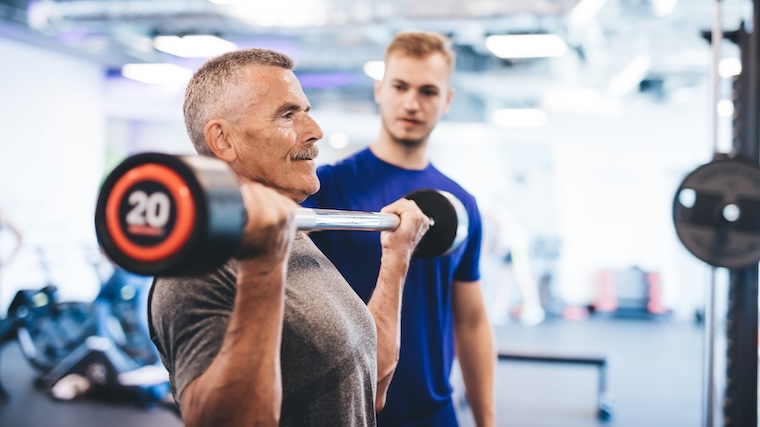
The only exception to this rule is if the exercise is super easy to perform even after adding five pounds or one rep. However, if the increase is remotely challenging, stick with the minimum load increase.
7. Proactive Deloads
Deloading means either taking time off from resistance training or significantly reducing the volume and intensity of a workout. Dr. Israetel states that folks over 40 should deload every four to six weeks by taking a full week off from working out.
A deload week can reduce fatigue and joint stress and make the muscles more sensitive to growth upon return to the gym.
8. One Low Month Of Volume
Every five months or so, take a full month of deloads. As in the tip above, the purpose is to reduce wear and tear on the joints and connective tissues, reduce fatigue, and heal the body for another five months of productive training. This low-volume month can look as follows:
- First two weeks: 1-2 sets per muscle per session.
- Last two weeks: two weeks off.
[Related: The 8 Best Whey Isolate Protein Powders, Tested by Our Experts]
9. SFR and Choosing Lifts Wisely
The Stimulus Fatigue Ratio (SFR) compares the ratio of muscle stimulus to overall fatigue. This strategy aims to have high muscle stimulation with lower mental and physical fatigue.
However, before implementing this strategy, understand some of the variables involved in Dr. Israetel’s definition of muscle stimulus:
- How much tension is in the targeted muscle?
- How much burn after high reps?
- How much of a pump from multiple sets?
- How weak and shaky targeted muscles get after a lift?
The goal is to maximize those variables while decreasing pain in joints and connective tissue and reducing systemic and psychological fatigue. Choosing the right exercises is a vital component of SFR. Dr. Israetel proclaims that choosing lifts wisely is the key to protecting the body and maximizing workouts.
For example, instead of heavy barbell back squats, choose hack squats. The latter provides better position and form and reduces the load on the spine.
The selection of the hack squat also aligns with the doctor’s emphatic declaration to become a “master of technique,” which includes slow eccentrics, controlled pausing, and perfect positioning. Mastering those can increase stimulus, reduce fatigue, and decrease the chances of injury.
10. Gain Weight If Already Lean
Older lifters should only try gaining weight if they are already lean. Aim for four to eight weeks of gaining tissue at a rate of half a pound per week. Then, alternate that period with a phase of reducing body fat. Otherwise, aim for 15 percent body fat and use that as a “base of operation.”
11. Be Careful With Gains
For those who can gain half a pound per week over that four-to-eight-week period, don’t exceed 20 percent body fat. Rest before leaning back down to 15 percent body fat.
For older lifters, muscle gain and fat loss stress the body and organs more. Remaining within this range of 15 to 20 percent body fat is ideal for preventing potential health risks.
With that in mind, Israetel recommends checking blood work after gaining phases to ensure no health issues.
More Training Content
Featured image via Shutterstock/PHOTOCREO Michal Bednarek
This article was originally published by a barbend.com . Read the Original article here. .